
No you don’t need to eat salads for weight change. I mean, you should eat salads for the nutritional benefit, but it shouldn’t be the only meal that you eat.
As I mentioned in my previous post, you can lose or gain weight by controlling your eating and/or exercise. But, why does this work?
The bucket filling analogy
Let’s look at three scenarios:
- Scenario 1 – A normal bucket
- Scenario 2 – A bucket with a hole in the side of it
- Scenario 3 – A bucket with a hole in the side of it, plus rain and evaporation affecting it
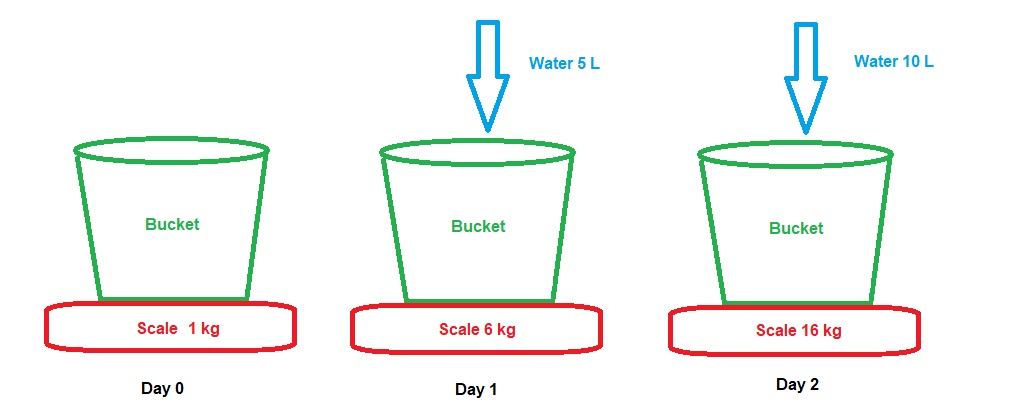
You have an empty bucket that is 1 kg. On Day 1, you fill the bucket with 5L of water then measure the weight of the bucket. The bucket now reads 6 kg. On Day 2, you fill the bucket with 10L of water. You then measure the bucket. The bucket now reads 16 kg.
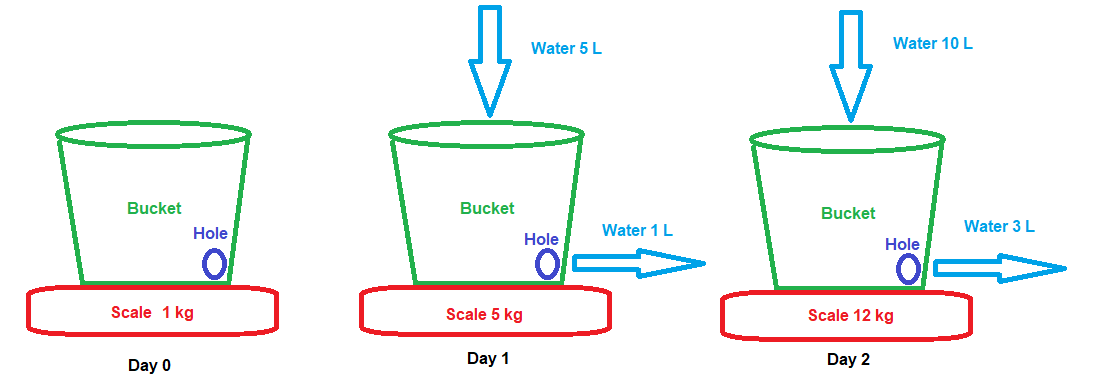
You have a similar bucket to Scenario 1, but with a small hole on the side of the bucket that we can change. When you weight the empty bucket you get 1 kg. You then add 5L of water to the bucket and also lose 1L of water from the bucket because of the hole. If you measure the bucket, you will get 5 kg. If you then add 10L and lose 3L because you changed the size of the hole, measuring the bucket then gives you 12 kg.
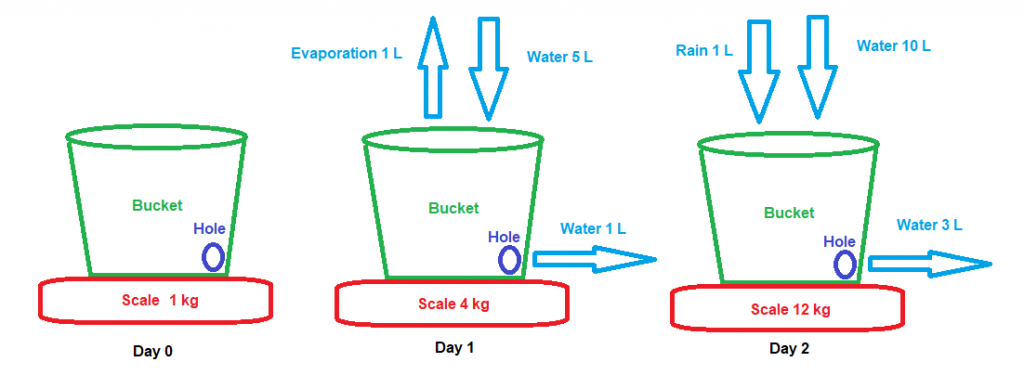
You have a similar bucket to Scenario 2, but now it’s opened to the air. Just like the previous example, the bucket initially weighs 1 kg. You then add 5L of water to the bucket and also lose 1L of water from the bucket because of the hole. However, you now also lose 1L because of water evaporating from the bucket. When you measure the bucket, it now gives you 4 kg. If you then add 10L water, lose 3L you changed the size of the hole and it rains, filling the bucket up by 1L, measuring the bucket will then give you 12 kg.
What can we see with this example?
Now, replace the following in the previous scenarios:
- Replace the bucket with a human
- Replace adding water to the bucket with eating food
- Replace losing water because of the hole with exercise
- Replace evaporation and rain as how the body varies between days and between person to person.
It is easy to see that two of the things above (eating food and exercising), are things we can directly control that makes us change weight. The body variations, however, we cannot control in the practical sense of weight change.
This doesn’t mean that we should abandon weight change because we can’t control everything.
All that we should do is keep in mind that there are things that affect weight change that we can’t control. We shouldn’t be too concerned should we see fluctuations in weight on a day to day basis that doesn’t make us too happy as well.
Now that I’m done explaining the above, we can go ahead with calculating how many calories your body requires in a day.
A few terms to make things clear
BMR: Basal Metabolic Rate
This term describes the energy (measured in calories (kcal or cal)) that your body requires to maintain bodily functions. This can be things like energy for breathing or energy to allow your brain to function. This shows the calories used when you are in a comatose state.
EAT: Exercise Activity Thermogenesis
This is a term to describe all energy used to do exercise. Things like running, going to the gym and biking all require extra energy, and this term accounts for these additional factors.
NEAT: Non-exercise Activity Thermogenesis
This is a term to describe all energy used to do things that are not strict exercises. For example, driving a car and even washing dishes contributes to NEAT.
TEF: Thermic Effect of Food
This term describes the energy required to process the food you eat, and varies based on the food you eat. Protein generally has the highest energy requirements to digest.
TDEE: Total Daily Energy Expenditure
This is a term to describe your total calorie requirements for a day. This is the sum of the previous terms:
TDEE = BMR + EAT + NEAT + TEF
So, what does this mean for us?
Once we have an estimate of our TDEE, if we eat less than that value, we tend to lose weight. When we eat more than that value, we tend to gain weight. If we go back to my previous point: “If you eat less and move more, you will lose weight”, it is easier to see from this equation above. Now, I am not saying that you will definitely lose weight, but it brings me to my next point.
Calories in vs. Calories Out
There are many people who do not believe in calories in/calories out. They believe the human body cannot be reduced to something so simple, as the body is complicated and that there are other issues that affect how easy or difficult it is to change weight. They believe that the human body is not a machine, and that the laws of thermodynamics don’t work in this case.
So why do I think that this works?
Nature does its own thing. We try to observe nature, and come up with reasons as to why things exist the way they are. We then use maths to formulate equations (where possible) to try and predict the things we observe. The laws of thermodynamics is based on the observations in nature.
Calories in, in a food sense, is the amount of energy going into your body. This is normally obtained when we eat food.
Calories out, in the same sense, is the amount of energy leaving your body. As I explained in the TDEE calculation, energy leaves your body due to BMR, EAT, NEAT and TEF. You can somewhat control EAT, NEAT and TEF. However, BMR is something you can’t control entirely. Things such as polycystic ovary syndrome (PCOS) and hypothyroidism/hyperthyroidism affect your BMR. This in turn makes it much more difficult to track your TDEE.
You can still do it!
This does not mean that you cannot change your weight if you suffer from these conditions.
It just makes it a bit harder. But if we understand the nature of calories in and calories out, you can see that there are things you can control (EAT, NEAT and TEF) and things you can’t control entirely (BMR). So to change our weight, we should focus on things we directly influence.
So how do we know how to get these calories?
One thing to keep in mind, is that getting your calories in (food eaten) and calories out (exercising, BMR) is just an estimation, and is not way a certainty. In order to accurately tracking the energy taken in from foods and energy lost from normal body functions and exercise, you need to be in a laboratory setting strictly measuring these energy flows. However, we have a good idea based on studies performed in the past, of what your estimate of your calories should be.
The Mifflin St. Jeor Equation
Thanks to a paper written in the 90s, there is an equation that you can use to give you a rough estimate of your BMR. Now, for those thinking, “Oh, that is a study done 30 years ago, it can’t hold up that well”, you’d be surprised to find out that the Mifflin St. Jeor equation still holds up as being more accurate compared to the other formulas that exist. For our purposes, it is much more practical. The Mifflin St. Jeor equation can be found below:
BMR = 9.99 x Weight (kg) + 6.25 x Height (cm) – 4.92 x Age + 166 x Sex – 161
with Sex: males = 1, females = 0
Ideally, you would also have to know your body fat percentage to make the estimation of your BMR even more accurate. The issue is that fat measurement is highly inaccurate. Even with the most sophisticated equipment that we have available, there is are still errors that are present when performing these measurements.
An example for how to calculate BMR
Let’s say we have a person with the following stats:
- Male
- 28
- 90 kg
- 172 cm
Lets put these values in the equation:
BMR = 9.99 x 90 + 6.25 x 172 – 4.92 x 28 +166 x 1 – 161
BMR = 1841 calories
So the BMR of this individual approximately 1841 cal, which means that if he was in a coma, this is how many calories he would burn to maintain normal body functions.
I have included a BMR Calculator at the bottom of this post to help you determine your BMR based on your body measurements.
If the individual was an average person and ate 1841 calories, he would lose weight. Why is that? Remember, BMR forms a part of the TDEE and that by simply moving you require energy. This means that your energy requirements are higher. Which then goes back to my previous statement, “Losing weight can be reduced to eating less and moving more”.
BMR is also dependent on your body composition. If you have more muscle, your BMR tends to be higher because you require more muscle to maintain it. If you have more fat, your BMR tends to be lower.
What’s next?
Now that we have an idea on how to estimate the calories we require, we are now a step closer to making change to improve our quality of life via the foods we eat and the exercise we perform.
HOWEVER, just because we eat at those calories we estimate, doesn’t mean that we will feel good eating it. For example, the male in the above example can eat 1841 calories of Nik Naks chips and still lose weight. 1841 calories of Nik Naks is around 330 grams of Nik Naks. But he will feel terrible because Nik Naks chips, while tasting good, is not as nutritionally good. He is also likely to feel hungry soon after eating the chips.
Likewise, we can eat 1841 calories of broccoli. Just a note, 1841 calories of broccoli requires you to eat around 5.5 kg of broccoli a day. I’ve never been able to eat even 300 g of broccoli in one day. Trust me, I’ve tried it and it’s just terrible. 5.5 kg in a day is just too extreme.
My point is that the foods you eat to make a weight change need to make you feel good, but most importantly, make you satiated. The more satiating your diet is, the easier it is to adhere to, as you will not feel hungry all the time. Also, incorporating foods that you like into a diet tends to increase adherence to your diet.
Closing remarks
My next post is most likely going to be about how to start a meal plan for yourself. I will outline some principles that I use to choose the meals that I eat, and will give you an idea of my current meal plan.
I thank you all for reading my posts.